Doodle School Font Review: A Playful Addition to Your Design Toolkit
There’s something oddly satisfying about opening a blank brand board and letting your creativity flow. For a recent boutique identity project, I found myself staring at a white canvas, trying to figure out the right font to anchor the visual system. That’s when I stumbled upon Doodle School. It wasn’t just another block font—it was a character in its own right, full of personality and charm.
A Handmade Block Font with Personality
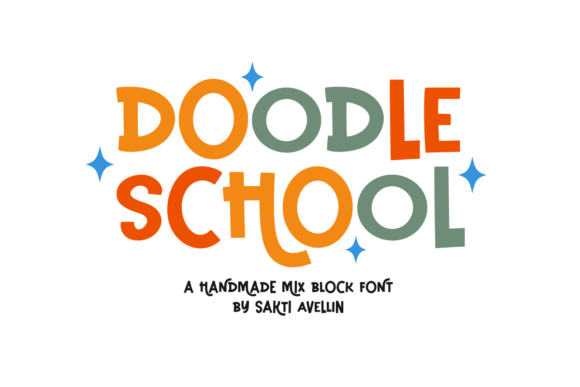
Doodle School is an adorable one-of-a-kind handmade block font that exudes playful charm. Its design feels like it was crafted by hand, with subtle imperfections that give it a warm, approachable feel. The unique design allows for blending uppercase and lowercase letters, creating a compelling mix that feels both modern and nostalgic.
What sets Doodle School apart from other block fonts is its flexibility. It’s not just for headlines or logos; it can be used in a variety of ways depending on how you manipulate the letterforms. Whether you’re using it as a display font, headline font, or even an accent font, it has a way of making your designs feel more personal and less sterile.
Testing Doodle School in Real Branding Projects
I first tested Doodle School on a logo concept for a local café. The goal was to create something that felt inviting and whimsical—something that would make customers want to come back. After sketching a few ideas, I settled on a simple, clean logo that paired Doodle School with a sans serif font for balance. The result was a logo that felt both professional and playful, exactly what the client was looking for.
I also used Doodle School on a packaging mockup for a skincare product line. The font worked beautifully on labels and tags, adding a touch of charm without overwhelming the design. It was especially effective when used in combination with a minimalist layout, where the font’s personality could shine through without competing with other elements.
On a website header, Doodle School brought a sense of warmth and approachability. It was perfect for a small business owner who wanted to convey friendliness and authenticity. I even used it on social media graphics for a creative studio, where it added a whimsical touch to otherwise professional content.
Font Pairing and Versatility
One of the strengths of Doodle School is its versatility. It pairs well with a range of other fonts, depending on the project. For a more formal look, I’ve used it alongside a serif font like Georgia or Times New Roman. For a more modern aesthetic, pairing it with a sans serif like Helvetica or Montserrat creates a nice contrast.
If you’re looking for a decorative font, Doodle School is a great choice. It works especially well in short phrases, such as taglines or headings, where its playful nature can really come through. However, it’s important to note that Doodle School may not be the best choice for long body text or small sizes, where readability could become an issue.
For those interested in exploring Doodle School further, it’s worth checking out the included styles, alternates, ligatures, swashes, weights, and multilingual support. These features add depth and flexibility, allowing you to tailor the font to different design needs.
Considerations Before Using Doodle School
Before jumping into a client project with Doodle School, it’s always a good idea to test it in different contexts. How does it look on a shop sign? On a product mockup? On a printed card? Taking the time to evaluate these scenarios can help ensure the font works well within the overall design system.
It’s also important to consider the intended use of the font. While Doodle School is excellent for branding projects that lean towards a playful or handmade aesthetic, it may not be suitable for corporate or formal settings. If your project requires a more professional or serious tone, you might want to explore other options.
Finally, don’t forget to review the commercial font licensing before using Doodle School in client work, brand identity, packaging, templates, merchandise, websites, digital products, or print-on-demand products. Ensuring proper licensing is crucial for both legal compliance and maintaining the integrity of your design work.